
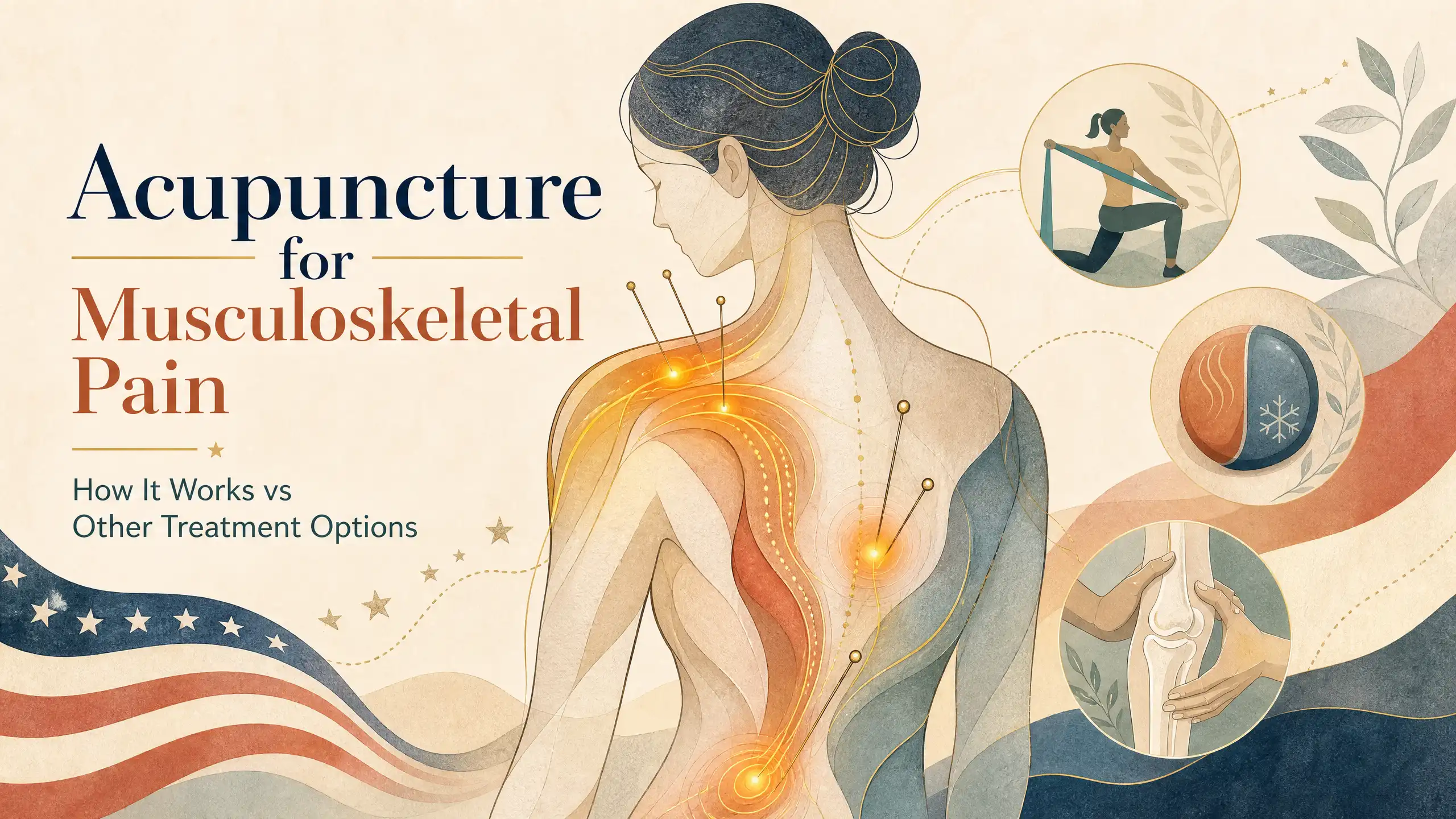
Acupuncture for Musculoskeletal Pain: How It Works vs Other Treatment Options
Definition:
Acupuncture for Musculoskeletal Pain uses thin needles at selected points to influence pain signaling, muscle tension, and nervous system activity without relying on pain medication.
TL;DR:
Acupuncture may help reduce pain and improve function in conditions such as chronic low back pain, neck pain, knee osteoarthritis, shoulder pain, and myofascial pain. Its effects appear to involve the nervous system, natural pain-control chemicals, local tissue responses, and pain modulation.
Key points include:
- Acupuncture provides a non-drug option for managing several chronic pain conditions.
- Physical therapy and acupuncture can often be used together rather than treated as competing options.
- NSAIDs, opioids, injections, and acupuncture each have different benefits and limitations.
- Persistent, severe, or unexplained pain still requires proper medical evaluation.
A 2025 evidence map published in Frontiers in Medicine examined 111 systematic reviews covering 35 musculoskeletal pain conditions. Many results favored acupuncture for short-term pain relief, although the researchers also found weaknesses in the quality of the available reviews.
Table of Contents
What is musculoskeletal pain?
Musculoskeletal pain affects muscles, bones, joints, tendons, ligaments, or related soft tissues. It may result from injury, repetitive strain, arthritis, poor movement tolerance, inflammation, muscle tension, or changes in how the nervous system processes pain.
Common examples include chronic low back pain, neck pain, shoulder pain, knee osteoarthritis, tennis elbow, plantar heel pain, tendinopathy, sciatica, and myofascial pain.
Why can chronic musculoskeletal pain be hard to treat?
Chronic pain is often more complicated than an injured tissue simply continuing to hurt. Over time, the nervous system can become more sensitive to pain signals, while muscle guarding, reduced movement, weakness, stress, and fear of movement may reinforce the pain cycle.
This is why long-term treatment often needs more than temporary symptom relief.
How does acupuncture work for musculoskeletal pain?
Acupuncture involves placing very thin needles into selected acupuncture points or areas related to the painful region.
What happens in the nervous system during acupuncture?
Needle stimulation activates sensory nerves that send signals toward the spinal cord and brain. These signals may influence how the central nervous system receives and processes pain.
Research has also linked acupuncture with endogenous opioid peptides such as beta-endorphin and enkephalin. These are chemicals naturally produced by the body that take part in pain regulation.
In simple terms, acupuncture may affect both the painful area and the way the brain and nervous system interpret pain signals.
Can acupuncture help tight muscles and trigger points?
Acupuncture can also be directed toward tender muscles and myofascial trigger points.
Trigger points are sensitive areas in muscle tissue that may produce local pain or pain felt elsewhere in the body. Needle stimulation may reduce muscle guarding and sensitivity in some patients, making movement and rehabilitation more comfortable.
What is electroacupuncture?
Electroacupuncture is a form of acupuncture in which selected needles are connected to a device that sends a mild, controlled electrical pulse.
Research suggests that different stimulation frequencies can influence pain-related nervous system pathways and endogenous opioid activity in different ways.
Electroacupuncture is not automatically better than manual acupuncture. Studies show different results depending on the condition being treated, so the choice should be based on the patient’s symptoms, response, and clinical assessment.
How does acupuncture compare with other pain treatments?
No single treatment is best for every musculoskeletal problem. Each option addresses pain differently.
Treatment | Main Benefit | Main Limitation |
Acupuncture | Non-drug pain modulation with relatively few side effects when properly performed | Results vary by patient and condition |
NSAIDs | Fast pain and inflammation relief | Long-term or frequent use may increase gastrointestinal, kidney, and cardiovascular risks |
Opioids | Strong pain relief in selected situations | Dependence, overdose, tolerance, and other adverse effects |
Corticosteroid injections | Can reduce inflammation quickly | Benefits may be temporary and repeated injections carry added risks |
Physical therapy | Builds strength, mobility, and physical function | Requires active participation and time |
Acupuncture + PT | Combines symptom relief with rehabilitation | Needs an individualized treatment strategy |
Is acupuncture safer than NSAIDs?
Musculoskeletal pain can feel different depending on the affected structure.
Bone pain is often described as a deep ache, while muscle pain may feel like soreness, tightness, or a sharp sensation during movement. Joint pain may involve stiffness, swelling, burning, or grinding sensations.
Tendon and ligament pain often becomes worse when the affected area moves because these tissues help control movement and stability.
Can Stress and Sleep Affect Musculoskeletal Pain?
Acupuncture avoids the systemic drug exposure associated with NSAIDs such as ibuprofen and naproxen.
NSAIDs can be useful for short-term pain, but regular or high-dose use may increase the risk of gastrointestinal bleeding, kidney problems, and cardiovascular events in some patients.
Acupuncture has risks too. Minor bruising, soreness, or temporary bleeding may occur, while serious complications are uncommon when treatment is performed by a properly trained practitioner using sterile, single-use needles.
Can acupuncture replace opioids?
Acupuncture may be included in a non-opioid pain-management strategy, but it should not be treated as an automatic replacement for prescribed opioid medication.
Patients taking opioids should speak with the clinician managing their medication before reducing or stopping it.
Acupuncture vs corticosteroid injections: Which lasts longer?
Corticosteroid injections can provide relatively quick relief by reducing inflammation around selected joints and soft tissues. However, the duration of benefit varies, and repeated injections may raise concerns about cartilage, tendon, or other tissue effects.
Acupuncture generally involves a series of treatments rather than one injection.
Some research suggests that acupuncture benefits can continue after the treatment period ends, but there is no fixed duration that applies to every patient.
Should you choose acupuncture or physical therapy?
Physical therapy is often valuable when pain involves weakness, reduced mobility, poor movement mechanics, injury recovery, or the need for progressive strengthening.
Acupuncture may be helpful when pain sensitivity, muscle tension, or discomfort makes normal movement or exercise difficult.
That creates a useful treatment relationship: acupuncture may reduce symptoms while physical therapy works on strength, mobility, and long-term physical capacity.
What does research say about acupuncture for musculoskeletal pain?
Research supports acupuncture as a reasonable treatment option for several chronic musculoskeletal pain conditions, but evidence is stronger for some conditions than others.
A 2025 evidence map reviewed 111 systematic reviews involving 35 musculoskeletal conditions. Low back pain had the largest research base, followed by osteoarthritis, with additional research covering neck pain, shoulder pain, sciatica, fibromyalgia, myofascial pain, rheumatoid arthritis, and other conditions.
A major individual-patient meta-analysis involving 17,922 people also found acupuncture more effective for chronic pain than both sham acupuncture and no-acupuncture controls.
What conditions may be treated with acupuncture?
Acupuncture is commonly considered for several muscle and joint problems, including:
- Chronic low back pain, neck pain, and shoulder pain.
- Knee osteoarthritis and selected forms of joint pain.
- Myofascial pain, muscle tension, and trigger-point-related pain.
- Selected cases of sciatica, plantar heel pain, tennis elbow, and tendinopathy.
Diagnosis matters. For example, shoulder pain may result from muscle tension, tendon irritation, arthritis, nerve irritation, or a significant rotator cuff injury, and each condition may require a different treatment plan.
When should acupuncture not be your first step?
Acupuncture should not delay medical evaluation when symptoms could indicate a serious problem.
Seek medical care first if pain occurs with:
- Major trauma, suspected fracture, or sudden loss of function.
- New or progressive muscle weakness or severe numbness.
- Loss of bladder or bowel control associated with severe back symptoms.
- Fever, major swelling, unexplained symptoms, or rapidly worsening pain.
Acupuncture can help manage pain, but it cannot repair a fracture, reconnect a completely torn tendon, or replace surgery when a structural problem requires surgical treatment.
What happens during your first acupuncture session?
A musculoskeletal acupuncture appointment should begin with an assessment.
The practitioner may ask where the pain occurs, when it started, what movements make it worse, what treatments you have already tried, and how the condition affects everyday activities.
Treatment may involve needle placement near the painful area and at other selected acupuncture points. Depending on the condition, manual acupuncture or electroacupuncture may be considered.
How many acupuncture sessions will you need?
There is no universal number of treatments.
Some patients notice early changes within the first few sessions, while chronic conditions may require a longer series. Tara Acupuncture describes roughly six to twelve visits as a possible treatment range for some pain patients, depending on symptoms and response.
Does insurance cover acupuncture in New York?
Many insurance plans provide some acupuncture benefits, but coverage varies by policy, diagnosis, provider network, deductibles, copays, and annual visit limits.
Does Medicare cover acupuncture?
Original Medicare Part B covers acupuncture for qualifying chronic low back pain under specific conditions.
Medicare currently allows up to 12 visits in 90 days, followed by eight additional sessions when improvement is documented, for a maximum of 20 treatments in a 12-month period.
Coverage does not automatically extend to every muscle or joint condition.
FAQ's
Does acupuncture work for muscle pain?
Yes, acupuncture may reduce muscle pain and tension in some patients, particularly when chronic pain or myofascial trigger points are involved.
Is acupuncture good for joint pain?
Acupuncture may help some forms of joint pain, with particularly notable research involving knee osteoarthritis.
Is acupuncture painful?
Most patients feel little more than a brief pinch, pressure, heaviness, warmth, or tingling during treatment.
How quickly does acupuncture work for pain?
Some patients notice changes within a few treatments, while chronic conditions may require several sessions before meaningful improvement appears.
Can acupuncture and physical therapy be done together?
Yes, acupuncture can help manage pain while physical therapy focuses on movement, strength, mobility, and long-term function.
How long can acupuncture pain relief last?
Relief may last from a short period to several months depending on the condition, treatment response, and other factors.
What should you do next?
Acupuncture does not need to replace every medication, injection, or rehabilitation treatment to be useful.
For many people with chronic musculoskeletal pain, the better strategy is to match treatment to the cause of the problem. That may mean combining pain reduction through acupuncture with exercise, physical therapy, medical management, and changes in daily activity.
If medication provides only temporary relief, pain makes rehabilitation difficult, or you want to discuss a non-drug treatment option, an acupuncture assessment can help determine whether it fits your condition.
