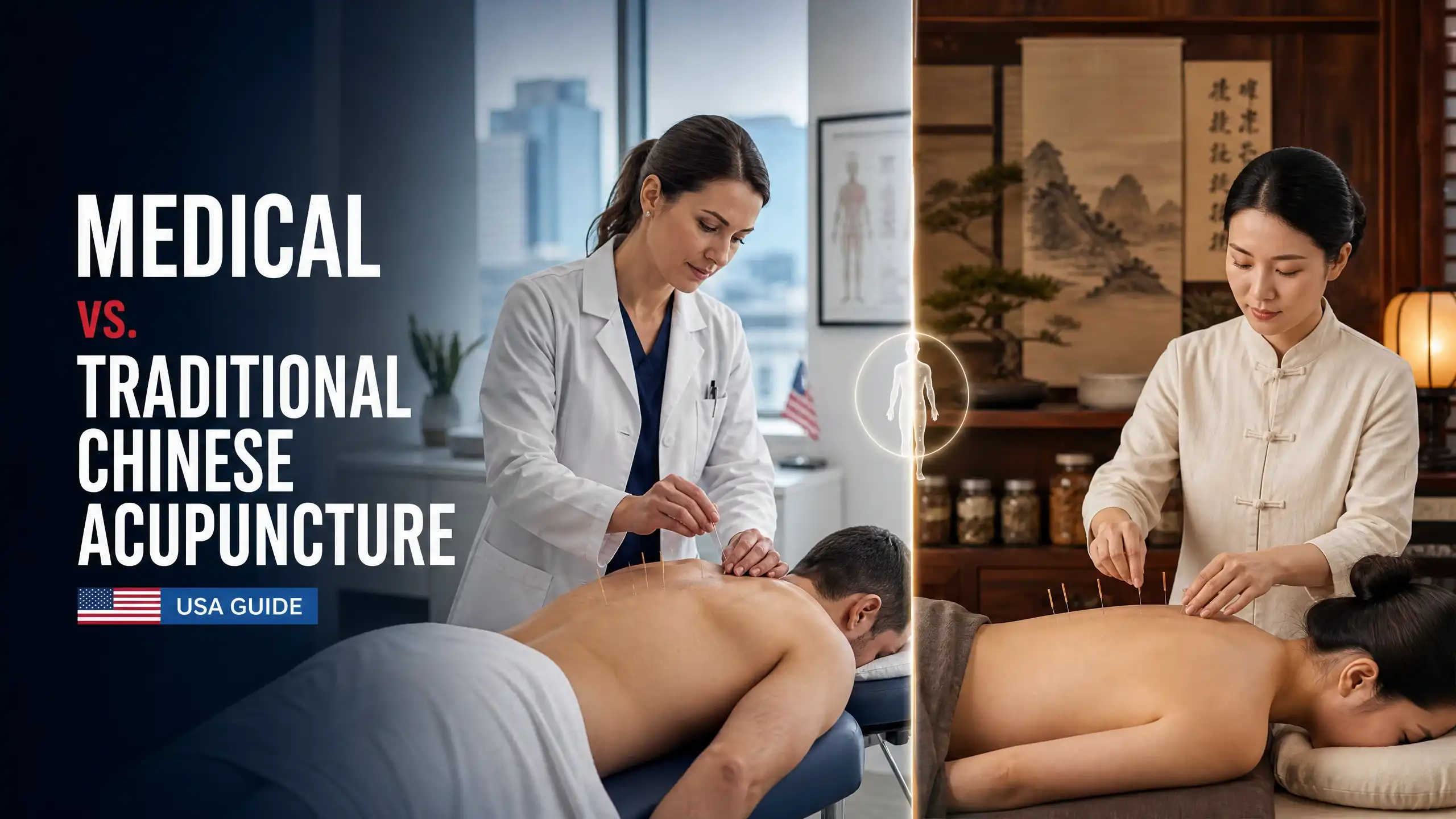
Medical vs. Traditional Chinese Acupuncture: Which Type Is Right for You?
Definition:
Medical acupuncture integrates acupuncture with contemporary biomedical care, while Traditional Chinese acupuncture uses acupuncture within the broader framework of Traditional Chinese Medicine.
Choosing between medical acupuncture and Traditional Chinese acupuncture can be confusing because both use thin needles, yet they may approach diagnosis, treatment planning, and patient care very differently.
The better question is not which system is universally “best.” It is which approach fits your condition, care preferences, medical history, and practitioner needs.
TL;DR:
Medical acupuncture uses acupuncture within a biomedical model based on anatomy, physiology, diagnosis, and conventional healthcare. Traditional Chinese acupuncture uses the framework of Traditional Chinese Medicine, or TCM, including concepts such as qi, meridians, yin and yang, and pattern diagnosis.
- Medical acupuncture may fit you better if you want treatment closely connected to conventional medical diagnosis.
- Traditional Chinese acupuncture may fit you better if you prefer a TCM-based, whole-person assessment.
- Neither approach is automatically safer or more effective. Practitioner training, your condition, and treatment quality matter more.
- The two approaches can overlap. Some practitioners combine traditional acupuncture methods with modern biomedical reasoning.
Table of Contents
Medical vs. Traditional Chinese acupuncture at a glance
Comparison point | Medical acupuncture | Traditional Chinese acupuncture |
Core framework | Biomedical medicine | Traditional Chinese Medicine |
Main concepts | Anatomy, physiology, nerves, muscles | Qi, meridians, yin and yang |
Diagnosis | Conventional medical diagnosis and clinical assessment | TCM pattern diagnosis plus health history |
Point selection | Anatomical targets, trigger points, classical points | Acupuncture points selected by TCM patterns |
Practitioner | Often a physician or medically trained clinician | Commonly a licensed acupuncturist |
Treatment setting | Often integrated with conventional care | Often provided within a TCM practice |
Best fit | Patients who prefer biomedical integration | Patients who prefer a traditional framework |
Can they overlap? | Yes | Yes |
The biggest difference is usually why the practitioner selects certain points, not the needles themselves.
What is medical acupuncture?
Traditional Chinese acupuncture is acupuncture practiced within Traditional Chinese Medicine, or TCM.
TCM describes health through concepts such as qi, often pronounced “chi,” meridians, yin and yang, and patterns of imbalance. A practitioner may assess symptoms, sleep, digestion, energy, pulse, tongue appearance, and other factors before selecting acupuncture points.
Two people with similar headaches may therefore receive different treatments because the practitioner identifies different TCM patterns.
Traditional Chinese acupuncture often feels more whole-person because treatment is not limited to the location of one symptom. However, qi and meridians should be understood as concepts within the TCM framework rather than established anatomical structures in modern medicine.
How do medical and Traditional Chinese acupuncture differ in practice?
The main difference is the clinical reasoning behind treatment.
A medical acupuncturist may place a needle because of its relationship to a muscle, nerve, trigger point, joint, or pain pathway. A TCM practitioner may select the same or another point because of its relationship to a meridian or traditional diagnostic pattern.
That means two practitioners can sometimes use similar points while explaining them very differently.
Modern acupuncture research also suggests that treatment may influence the nervous system, local tissues, pain processing, and other physiological responses. Patient expectations and the clinical interaction may also contribute to treatment outcomes.
Is medical acupuncture more effective than Traditional Chinese acupuncture?

Research has not established medical acupuncture as universally superior to Traditional Chinese acupuncture.
Most clinical studies evaluate acupuncture for specific health conditions rather than comparing two complete treatment systems against each other.
Evidence is stronger for some pain-related conditions than for many other uses. Research has found possible benefit for problems such as:
- chronic back or neck pain
- knee pain related to osteoarthritis
- migraine and tension headaches
- some forms of postoperative pain
The practical takeaway is to ask whether acupuncture has reasonable evidence for your condition, rather than choosing solely based on whether a clinic calls its approach medical, Western, traditional, or holistic.
Which type of acupuncture is right for you?
Your diagnosis, treatment goals, practitioner qualifications, and preferred style of care should guide the decision.
Medical acupuncture may be a stronger fit if you already have a conventional diagnosis and want acupuncture closely coordinated with medical care. For example, someone recovering from an orthopedic injury may prefer a practitioner who discusses treatment in terms of anatomy, rehabilitation, and pain management.
Traditional Chinese acupuncture may be a stronger fit if you prefer TCM pattern assessment and want the practitioner to consider symptoms through a broader traditional framework. A blended approach can also make sense. Many practitioners combine classical acupuncture techniques with modern anatomy, research, and conventional health information.
The most important question is not simply “Which type?” It is “Who is treating me, what are they treating, and how will we know if it is working?”
What is the difference between a physician acupuncturist and a licensed acupuncturist?
A physician acupuncturist and a licensed acupuncturist usually follow different training pathways.
A physician acupuncturist starts as an MD or DO and later receives additional training in acupuncture. This can make acupuncture easier to integrate with diagnosis, medications, imaging, rehabilitation, and other conventional treatments.
A licensed acupuncturist, often identified as an LAc, usually completes professional education focused on acupuncture and related Chinese medicine subjects before meeting state licensing requirements. Acupuncture licensing rules vary across the United States, so patients should verify credentials with their own state licensing authority rather than assuming that every credential carries the same scope of practice.
Is one type of acupuncture safer than the other?
No. Safety depends more on practitioner training, sterile technique, patient selection, and proper needle placement than on the treatment label.
Acupuncture is generally considered low risk when performed correctly by an appropriately trained practitioner. Improper treatment can cause infection, bleeding, nerve injury, or, rarely, more serious complications such as a punctured organ.
Tell your practitioner about pregnancy, blood-thinning medication, implanted devices, bleeding disorders, infections, major illnesses, and prior surgeries before treatment.
What happens during an acupuncture session?
A typical acupuncture visit includes an assessment, insertion of thin needles, a short period with the needles in place, and removal before you leave.
Many appointments last about 30 to 60 minutes. A practitioner may use only a few needles or more than a dozen depending on the treatment plan. Needles often remain in place for around 10 to 20 minutes.
You may feel little during insertion. Some people notice mild pressure, warmth, tingling, heaviness, or an ache around the treatment point.
How many acupuncture sessions might you need?
There is no standard number of treatments for every patient.
Frequency depends on the condition, how long you have had it, symptom severity, and your response to treatment. Some treatment plans begin with one or two sessions per week, while others use a different schedule.
Before starting, ask how progress will be measured. For pain, that may include:
- lower pain scores
- better movement or range of motion
- improved sleep
- less reliance on pain medication
If your symptoms are not improving after a reasonable trial, discuss whether the plan should change rather than continuing indefinitely.
Does insurance cover medical or Traditional Chinese acupuncture?
Coverage depends on your insurance plan, diagnosis, provider, and state rules.
Commercial insurers may limit acupuncture to certain conditions, require an in-network provider, cap the number of visits, or require a referral.
Medicare Part B currently covers acupuncture for qualifying chronic low-back pain. Coverage begins with up to 12 treatments in 90 days and may include 8 additional sessions if the patient shows improvement, for a maximum of 20 treatments in 12 months.
Always check coverage before committing to a multi-session package.
Is medical acupuncture the same as dry needling?
No. Medical acupuncture and dry needling are related but not identical.
Dry needling commonly targets muscles, trigger points, and neuromuscular structures. Medical acupuncture may also treat these targets, but it can include traditional acupuncture points and a broader acupuncture treatment system.
The techniques can look similar, especially when needles are placed into myofascial trigger points. Training standards and legal scope also vary by state.
What should you ask before choosing an acupuncturist?
A qualified practitioner should be able to explain training, treatment goals, safety, and expected progress clearly.
Ask these questions before beginning treatment:
- What license and acupuncture training do you hold in this state?
- How often do you treat people with my condition?
- How many visits should we try before evaluating progress?
- How will you coordinate with my physician if my symptoms change?
Also ask about cost, insurance, treatment techniques, and whether other therapies will be included.
Be cautious with anyone who promises guaranteed results, claims acupuncture cures nearly every disease, discourages necessary medical testing, or cannot clearly explain professional credentials.
FAQ's

Is medical acupuncture better than Traditional Chinese acupuncture?
Neither is universally better. The right choice depends on your condition, treatment goals, practitioner qualifications, and preferred approach to care.
Does medical acupuncture actually work?
Medical acupuncture may help certain conditions, especially some types of pain. Results vary based on the condition, treatment plan, and individual response.
Is Traditional Chinese acupuncture scientifically proven?
Acupuncture has research supporting benefits for some conditions, particularly pain. However, traditional concepts such as qi and meridians are not established biomedical structures.
How long does acupuncture take to work?
Acupuncture has research supporting benefits for some conditions, particularly pain. However, traditional concepts such as qi and meridians are not established biomedical structures.
Does acupuncture hurt?
Acupuncture usually causes little discomfort because the needles are very thin. You may feel mild pressure, tingling, warmth, or a temporary ache.
How do I know whether an acupuncturist is qualified?
Check their active state license, education, professional credentials, and experience with your condition. Licensing requirements vary across the United States.
Can medical and Traditional Chinese acupuncture be combined?
Yes. Some practitioners combine traditional acupuncture techniques with biomedical anatomy, conventional diagnosis, and modern clinical research.
Who should be cautious with acupuncture?
People who are pregnant, take blood thinners, have bleeding disorders, infections, implanted devices, or serious health conditions should discuss acupuncture with a qualified healthcare professional first.
Which acupuncture approach should you choose?
Medical vs. Traditional Chinese acupuncture is not simply a contest between modern medicine and ancient medicine. Both involve acupuncture, but they organize diagnosis and treatment differently.
Choose medical acupuncture if you prefer a biomedical framework and close integration with conventional care. Consider Traditional Chinese acupuncture if you prefer a TCM-based, whole-person treatment model.
Whichever approach you choose, verify the practitioner’s credentials, ask how your progress will be measured, understand your costs, and keep necessary medical care in the picture.
The best choice is the approach delivered by a properly trained practitioner for a reasonable treatment goal, with clear expectations about what happens if acupuncture does not help.